When we travelled to the Yukon last year, I started to claim that I had been to every province and territory of Canada. It took a persnickety Newfoundlander to point out that although I’d been to that island, indeed many times, the actual name of the province was Newfoundland and Labrador, and I hadn’t been there.
This awareness coincided with my wife, Sally, reminiscing about the times, fifty years ago, that she had organized summer camps on the north shore of the St. Lawrence, and in 1974 taken a group of young teenagers across Canada, by bus, just to show them the world. “How are they doing?” she wondered.
Soon a trip was planned, and we drove to Moncton so we could catch a plane to Newfoundland. We flew back over PEI, which was a bit annoying, and after an hour or so the Dash-8 landed at the Deer Lake airport, a runway carved from the forest alongside the Humber River.
We left Deer Lake on Friday morning for the three-and-a-half hour drive up the Northern Peninsular to St. Barbe’s. With a half-hour queue for the Tim Horton’s drive-thru and a lengthy stop-over in Port au Choix, plus a few unanticipated photo-ops and the mandatory selection of road works, the trip took seven hours. Whatever, we were on holiday!
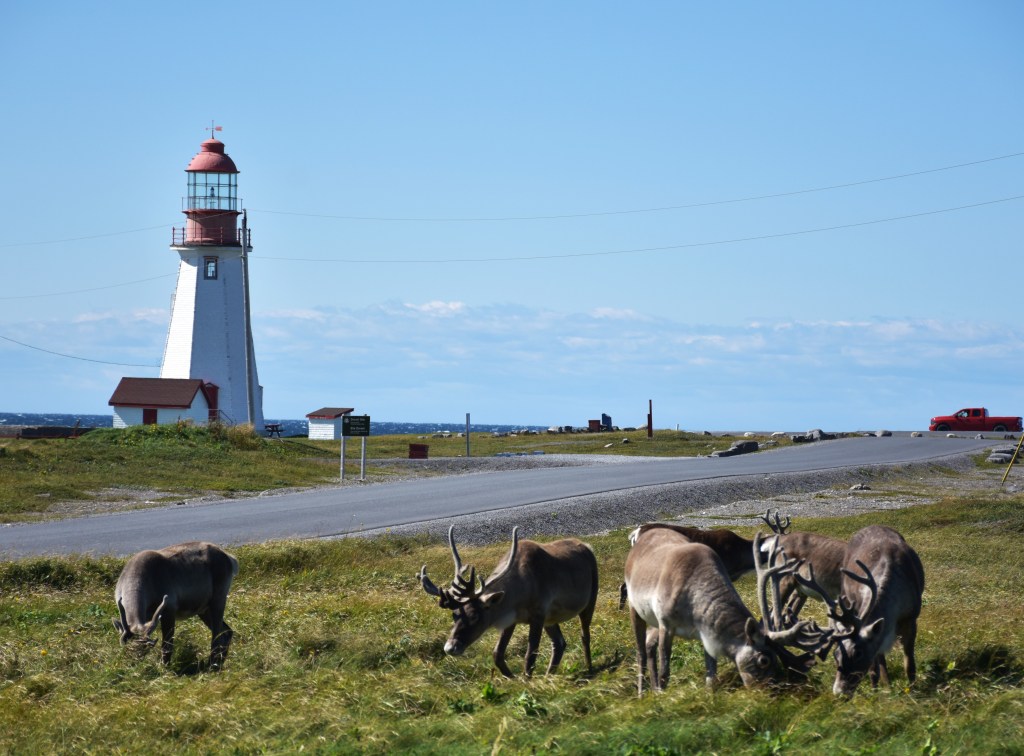
Port au Choix was a mixed blessing. We were delighted to see the herd of wild caribou for which the peninsula is renowned, a dozen or more of the animals wandering around the lighthouse area. The bulls were carrying full racks of antlers, the cows were shepherding their young. There were only three or four other cars out there at the end of the point, so we watched in a leisurely fashion and took some photographs.

Back into town for some lunch but the Anchor restaurant that I remembered from our last visit here appears to be closed, presumably a post-COVID casualty. We ended up at a small motel where the restaurant featured a shrimp sandwich. This was exactly as described – white bread, mayonnaise, and pink shrimps.

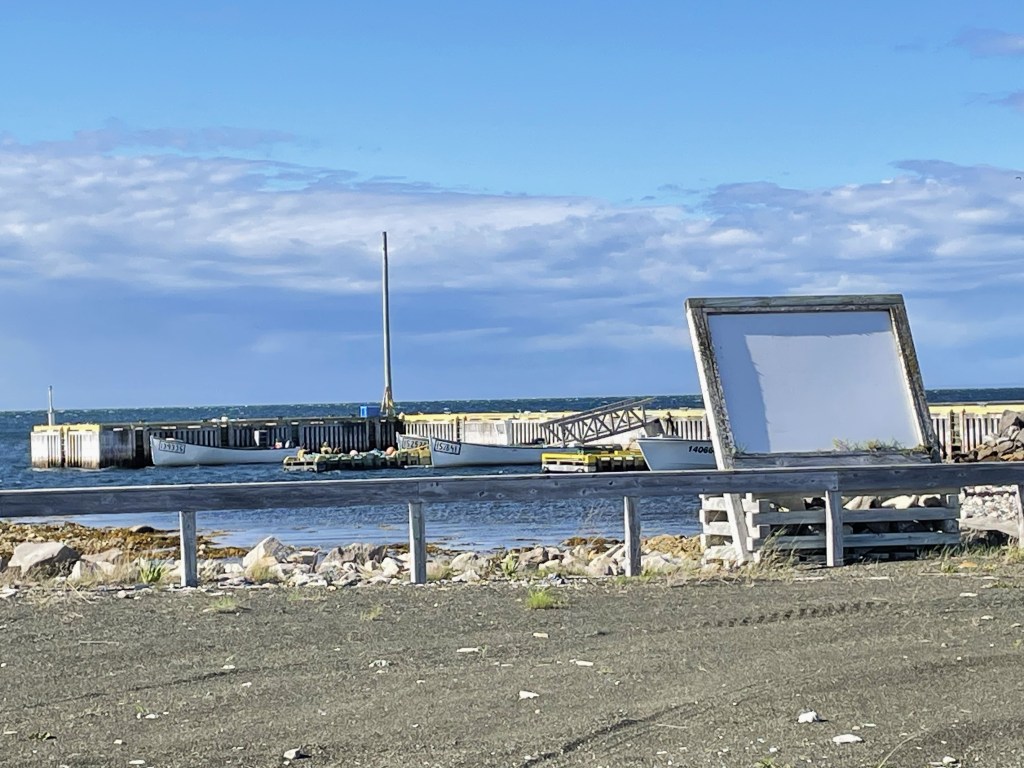
Afterwards we walked across the road and took photographs of the shrimp draggers which collect this bounty, something for which the northwest coast of Newfoundland is renowned.

And so, on to the thing for which Port au Choix is really famous, the Maritime Archaic and Dorset Palaeo-Eskimo settlements that have been excavated by archaeologists here since the 1960s. Indeed, the area is often described as the place where 9000 years of human history meet, an area which was not lost to time due to its raised elevation and the alkaline nature of the soils. Because of the cultural significance of the area, the site was officially designated a National Historic Site in 1970, and Parks Canada built a fancy interpretive centre to showcase some of the many artefacts which were recovered.
We went into the interpretive centre only to find that any and all artefacts related to the ancient burial sites of Port au Choix have been removed from public display. While I fully support the wishes of the Indigenous peoples of the area to make such a decision, I do think it’s a bit underhanded of Parks Canada to charge me admission in order to tell me that nothing is on display – a notice board outside would have done the trick.
Actually, information-sharing is at a premium in northern Newfoundland. From Port au Choix we went to Bird Cove, which according to the guidebook was visited by Cousin Jimmy (AKA Captain James Cook) in 1764. Regular readers of my blogs know that I claim kinship with the great navigator on the grounds that his village in North Yorkshire was equidistant between those of my maternal grandparents, and although what happens at the Goose Fair stays at the Goose Fair, one never knows …
Anyway, at Bird Cove we were promised a boardwalk with interpretive signs and drove around the small hamlet for 20 minutes without finding either. One gentleman sitting on his steps said “wha?” and another, after first checking that I wasn’t “one of those telemarketeer fellers,” pointed to what turned out to be a piece of 4×4 plywood stuck on a post, completely bereft of information.
We arrived at the motel at 5.00 pm. On checking in we were told that one of the two sisters who ran the restaurant had had a heart attack that morning, so there would only be a limited take-out menu served until 8.00pm. We took the key and went to our cabin.
The first thing we noticed was the “Boil Water” advisory on the table. The second was the grotty brown couch covered by a blanket of questionable provenance. The third was the clock on the wall, which was stuck at three thirty. I wonder if that meant that time stood still in the rest of Canada at three o’clock? [For non-Canadian readers, the joke here is that the vagaries of time zones means that things on television are always half an hour later in Newfoundland.]
There was a small kitchen, but no coffee, tea, or other welcome goodies. We went to the nearest Co-Op and picked up some necessary supplies. There were only 240-unit boxes of tea bags for sale, so we got chips instead. Back at the hotel we collected our take-away cod and chips from the surviving sister, who perhaps had other things on her mind as the meal was disgusting. Luckily, we had stopped at a gas station and bought some red liquorice ‘swizzle sticks’ and a couple of beers which served to supplement our ‘dinner’, so we coped.
The next morning, we went back to Flowers Cove, which we had last visited a decade ago. This is one of the two places on earth where you can find thrombolites, “critically endangered microbial structures … that were the only form of life from 3.5 billion to 650 million years ago.” So yes, they’re old. At least there is a sign now, and a trail – ten years ago we read about them courtesy of grade 6 science report posted in the local administrative office, where we had checked in to look for a bank where my friend Steve could change some English money.

The only other place known to have examples of these most primitive life forms is Shark Bay in Western Australia.
We went back to St. Barbe and caught the ferry that would take us across the Strait of Belle Isle, that narrow passage that separates Newfoundland and Labrador. It’s a modern ferry with all the technological gizmos required for 21st century travel, so it was refreshing to see that there was still a role for a grizzled old sea dog with a gaffing pole.

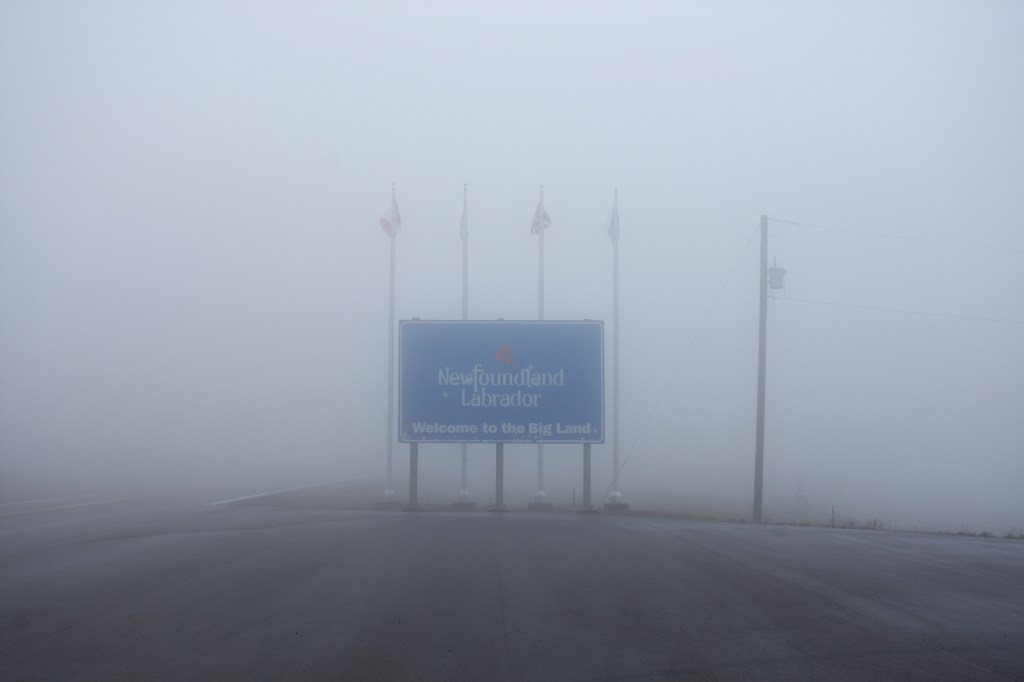
The ferry actually goes to Blanc Sablon, in Quebec, where because of the previously mentioned vagaries of time zones we arrived before we actually left Newfoundland. We drove up the hill past the oil tanks and joined the Trans Labrador Highway at kilometre 1, and at last I was able to say that now I’ve been to every part of Canada. Not every place, of course, but at least all the recognized geo-political regions.
So, Labrador at last, another place to seek traces of Cousin Jimmy’s passing through. I wonder what we’ll see here?
But that’s the next blog.
 J. Tim Goddard, PhD
Great to see this – for some reason I am not getting Sally’s journal.
>
LikeLike